Genitourinary Tract

Genitourinary Tract

   Home | About this Site | Feedback | Site Map
Friday, September 10, 2010               
 
 Spermatic Cord & Adnexa : Neoplasms
  Back to Testes | Return to Genitourinary Tract
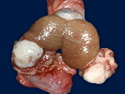
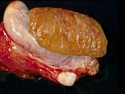
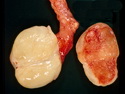
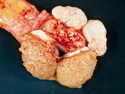
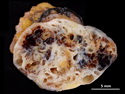
1: Adenomatoid Tumor
Comments: Adenomatoid tumor is the most common tumor of the epididymis and spermatic cord. It may be asymptomatic or present as a painless scrotal mass in the region of the head of epididymis or the lower pole of the epididymis (as seen here). The cut surface is firm, white-gray and homogenous.
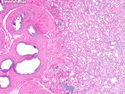
2: Adenomatoid Tumor
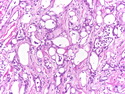
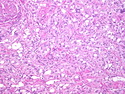
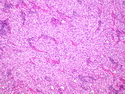
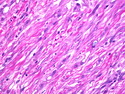
Comments: The tumor is composed of cuboidal or flattened epithelioid cells arranged in round, oval, or slit-like tubules, cords, and nests in a fibrous stroma. The borders may be infiltrative.
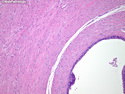
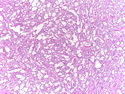
3: Adenomatoid Tumor
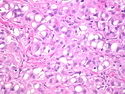
Comments: Large intracytoplasmic vacuoles are often present creating resemblance to fat or signet-ring cells. Nuclei lack any appreciable cytologic atypia and nucleoli are small and punctate.
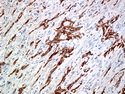
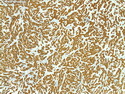
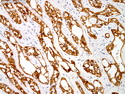
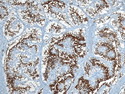
4: Adenomatoid Tumor : Cytokeratin AE1/AE3
Comments: The tumor cells show immunoreactivity for cytokeratin. Adenomatoid tumor appears to be mesothelial in origin. Even though it may be locally invasive, it is benign and has no metastatic potential.
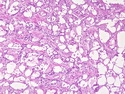
5: Adenomatoid Tumor
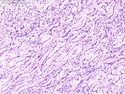
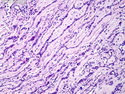
Comments: The nuclei in this adenomatoid tumor are slightly more plump than in the previous case; however, they still lack atypia. Differential diagnosis of adenomatoid tumor includes: metastatic carcinoma, malignant mesothelioma, and carcinoma of the rete testis.
6: Reactive Mesothelial Hyperplasia in a Hernia Sac
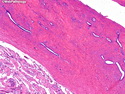
Comments: This inguinal hernia sac removed from a 4 year-old boy shows nodules of proliferating mesothelial cells. It was a focal process. It is a benign reactive condition that may mimic mesothelioma. Often there is history of trauma or some other insult to the sac. Rosai J, Dehner LP. Cancer 1975 Jan; 35(1):165-75.
7: Reactive Mesothelial Hyperplasia in a Hernia Sac
Comments: Higher magnification view shows lack of cytologic atypia in the mesothelial cells. Proper recognition of this entity is must to prevent overtreatment. Milstein R, Meyers KR. J Urol 1977 Mar; 117(3):391-2.
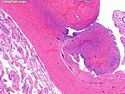
8: Benign Papillary Mesothelioma of Tunica Vaginalis
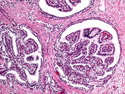
Comments: This benign papillary mesothelioma involved tunica vaginalis testis in a 49 year-old man. Other mesothelial lesions involving the paratesticular region include mesothelial cysts, reactive mesothelial hyperplasia, adenomatoid tumors, benign cystic mesothelioma, and malignant mesothelioma. Perez-Ordonez B, Srigley JR. Semin Diagn Pathol 2000 Nov; 17(4)294-306..
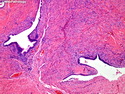
9: Benign Papillary Mesothelioma of Tunica Vaginalis
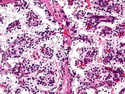
Comments: The papillae have a complex branching pattern and are lined by cuboidal cells. The stroma contain numerous lymphocytes and plasma cells. Ultrastructural and immunohistochemical studies have shown the lining cells to be mesothelial in origin.
10: Benign Papillary Mesothelioma of Tunica Vaginalis
Comments: The lining mesothelial cells have punctate nucleoli but otherwise lack cytologic atypia. The benign nature of this lesion should be emphasized in pathology report to prevent overtreatment.
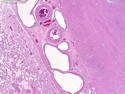
11: Papillary Cystadenoma of Epididymis
Comments: A benign tumor that accounts for about 35% of all primary epididymal neoplasms. About 40% of cases are bilateral and these cases are usually seen in the setting of von Hippel-Lindau syndrome. Molecular studies have shown allelic deletion of VHL gene in papillary cystadenoma of epididymis and related lesions. Shen T, et al. Int J Surg Pathol 2000 Jul; 8(3):207-212.
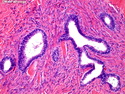
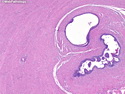
12: Papillary Cystadenoma of Epididymis
Comments: Histologically, papillary cystadenoma of epididymis consists of dilated ducts containing papillae lined by cuboidal epithelium. The cells have clear to lightly eosinphilic cytoplasm.
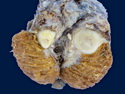
13: Liposarcoma of Paratesticular Region
Comments: This tumor shows typical features of a myxoid liposarcoma: scattered lipoblasts, a delicate plexiform capillary pattern, and abundant myxoid and hyalinized stroma. Spermatic cord is the most frequently involved site. Others include testicular tunics and epididymis. A large study of paratesticular liposarcomas has been published recently. Montgomery E, Fisher C. Am J Surg Pathol 2003 Jan; 27(1):40-7.
14: Liposarcoma of Paratesticular Region
Comments: Lipoblasts in various stages of differentiation can be seen here. Some nuclei show atypia. Paratesticular liposarcomas are treated by radical orchiectomy with high ligation of spermatic cord. About 25% cases develop recurrence, especially in patients with positive margins. About 10% of cases may develop metastases, especially those with undifferentiated or high-grade morphology.
15: Liposarcoma of Paratesticular Region
Comments: This example of myxoid and round cell liposarcoma arising in spermatic cord in a 65 year-old male shows occasional large multi-nucleated lipoblasts.
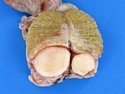
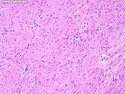
16: Embyronal Rhabdomyosarcoma of Paratesticular Region
Comments: Embryonal rhabdomyosarcoma removed from a 7 year old boy who presented with a scrotal mass. This is the most common sarcoma of paratesticular region in children.
17: Embyronal Rhabdomyosarcoma of Paratesticular Region
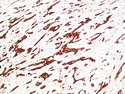
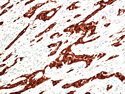
Comments: The tumor cells have large hyperchromatic oval or round nuclei. Abundant myxoid stroma separates individual tumor cells. Alveolar, botyroid and pleomorphic patterns are also occasionally seen. Muscle-specific actic and desmin were strongly positive in tumor cells.
18: Embyronal Rhabdomyosarcoma of Paratesticular Region
Comments: Another case of embryonal rhabdomyosarcoma showing small round blue tumor cells separated by abundant myxoid stroma.
19: Embyronal Rhabdomyosarcoma of Paratesticular Region
Comments: Same case as previous illustration. At high magnification, a few myoblasts with cross-striations were visible. Majority of tumor presenting in children are localized at the time of diagnosis and respond well to complete tumor resection and chemotherapy. Children above 10 years have a greater risk of nodal involvement and relapse. Ferrari A et al. J Clin Oncol 2002 Jan 15; 20(2):449-55.
20: Embyronal Rhabdomyosarcoma of Paratesticular Region
Comments: The tumor cells in this case of embyronal rhabdomyosarcoma are less differentiated than in previous illustrations. They have small round hyperchromatic nuclei, scant cytoplasm, increased mitotic activity and little or no evidence of myoblastic differentiation.
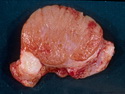
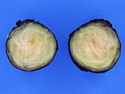
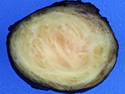
21: Leiomyosarcoma of Spermatic Cord
Comments: This was a 4.0 cm leiomyosarcoma arising in the spermatic cord of a 61 year old man. Paratesticular leiomyosarcoma is an extremely rare neoplasm. For a recent review of this tumor, refer to: Fisher C et al. Am J Surg Pathol 2001 Sep; 25(9):1143-9.
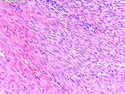
22: Leiomyosarcoma of Spermatic Cord
Comments: The histologic features are typical of those seen in other locations. Intersecting bundles of smooth muscle cells showing mild cytologic atypia and increased mitotic activity are seen.
23: Leiomyosarcoma of Spermatic Cord
Comments: Same case as previous illustration. Foci of highly atypical cells with multipolar mitotic figures (seen here) were also present which facilitated the diagnosis of leiomyosarcoma in this paratesticular mass.
24: MFH of Paratesticular Region
Comments: Rare cases of malignant fibrous histiocytoma are reported in the paratesticular region. This tumor has morphology of pleomorphic MFH.
25: MFH of Paratesticular Region
Comments: Like other sarcomas arising in this region, the treatment is radical inguinal orchiectomy with high ligation of the spermatic cord.
Last Updated: Tuesday, August 03, 2010
 
SLIDE INDEX
Brain
Head & Neck
Mediastinum
Lungs Pleura
Lymph Nodes Spleen
Heart Blood Vessels
Gastrointestinal Tract
Female Genital Tract
Genitourinary Tract
Prostate
Urinary Bladder
Kidney
External Genitalia
Testes
Adrenal
Bone & Cartilage
Soft Tissue
Peritoneum
Endocrine
Breast
Skin
 
SEARCH  
twitter