Genitourinary Tract

Genitourinary Tract

   Home | About this Site | Feedback | Site Map
Monday, September 06, 2010               
 
 Normal Prostate and Seminal Vesicles
  Back to Prostate | Return to Genitourinary Tract
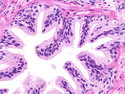
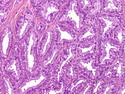
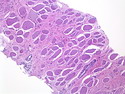
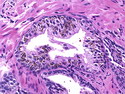
1: Normal glands
Comments: In this benign gland, the luminal contour shows tufts and papillary infoldings. The tall secretory epithelial cells have pale clear cytoplasm and uniform round or oval nuclei. Prominent nucleoli are not seen. Many basal cells can be identified.
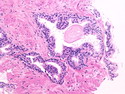
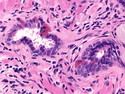
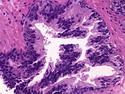
2: Normal glands
Comments: This benign gland contains corpora amylacea. Even at low magnification, basal cells can be clearly seen. Compare this with next slide which highlights the basal cell layer with the immunostain for high molecular weight cytokeratin 34bE12.
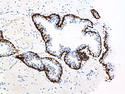
3: Normal glands - 34bE12 Immunostain
Comments: Basal cells are present in a continuous layer in most benign glands. The antibodies to high molecular weight cytokeratin 34bE12 stain basal cells but not secretory or stromal cells in the prostate. Besides cancer, the basal cell layer may be disrupted in atrophy, inflammation, atypical adenomatous hyperplasia (adenosis), and high-grade PIN.
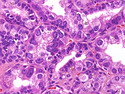
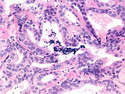
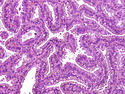
4: Seminal vesicle
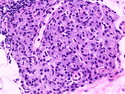
Comments: Highly atypical cells are a normal finding in the seminal vesicles of about 80% of older men. The nuclei are large, irregular, hyperchromatic, and show prominent nucleoli. The atypia is degenerative and not observed in the seminal vesicles of young men. When encountered in needle biopsies, it may be mistaken for adenocarcinoma.
5: Seminal vesicle - Older Man
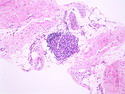
Comments: At low magnification, the complex papillary folds and irregular branching lumens of seminal vesicular mucosa become evident. Abundant golden-brown granules of lipofuscin pigment are present. Compare this image with next slide from the seminal vesicle of a relatively young man (age 45 yrs).
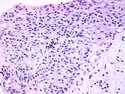
6: Seminal vesicle - Young Man
Comments: This seminal vesicle is from a 45 year-old man who underwent radical prostatectomy for prostate cancer. The pigment granules are scarce and are seen in the upper and lower right corners of the image.
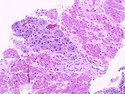
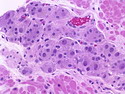
7: Neuroendocrine Cells in Atrophic Prostate Glands
Comments: Neuroendocrine cells are seen in benign prostate, high-grade PIN, and cancer. They are most abundant near verumontanum. In this image, many neuroendocrine cells with large eosinophilic granules (Paneth cell-like change) are seen in atrophic prostate glands.
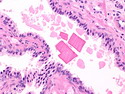
8: Prostate - Crystalloids in Benign Glands
Comments: Eosinophilic crystalloids are not specific for cancer. In this image, they are present within the lumen of a large benign gland. They can also be seen in atypical adenomatous hyperplasia (AAH), PIN, and other conditions.
9: Spermatozoa in Prostate Biopsy
Comments: Spermatozoa are seen in approximately 1% of prostate needle biopsies (unpublished personal observation).
10: Skeletal Muscle in Prostate Biopsies
Comments: Skeletal muscle fibers of the urogenital diaphragm extend into the apical and anterior peripheral regions of the prostate. Not infrequently, skeletal muscle fibers are seen in needle biopsies from those regions.
11: Ganglia in Prostate Biopsies
Comments: Ganglia are usually found in the fibromuscular tissue external to the prostate; sometimes, they may be found within the outer regions of prostate itself. In needle biopsies, they are usually located at one of the ends of the core.
12: Ganglia in Prostate Biopsies
Comments: Ganglia found in prostate needle biopsies should not be mistaken for high-grade carcinoma. Note the intracellular pigment and satellite cells around neurons.
13: Ganglia in Prostate Biopsies
Comments: Another example of ganglion sampled in a prostate needle biopsy.
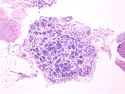
14: Paraganglion in Prostate Biopsies
Comments: Paraganglia are usually located external to the prostate near postero-lateral neurovascular bundles. Occasionally, they may be sampled in prostate needle biopsies.
15: Paraganglion in Prostate Biopsies
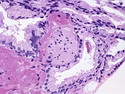
Comments: Paraganglia are composed of cells with clear or amphophilic cytoplasm, inconspicuous nucleoli, and a prominent vascular pattern. They are present within smooth muscle bundles away from benign acini. When present in prostate needle biopsies, paraganglia must be distinguished from high-grade adenocarcinoma.
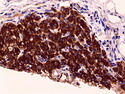
16: Paraganglion in Prostate Biopsies - Immunoreactivity for Synaptophysin
Comments: When present in prostate needle biopsies, paraganglia must be distinguished from high-grade prostatic adenocarcinoma. Prominent vascular pattern, degenerative atypia, lack of immunoreactivity for PSA and PSAP, strong immunoreactivity for neuroendocrine markers (image shows positivity for Synaptophysin), presence of sustentacular cells with S-100 protein favor paraganglion. Kawabata K. Arch Pathol Lab Med. 1997;121:515-516
17: Paraganglion in Prostate Biopsies
Comments: Another example of a paraganglion in a prostate needle biopsy. This one has an admixture of cells with clear and amphophilic cytoplasm. Note the prominent vascular pattern.
18: Perineural Indentation by Benign Prostatic Glands
Comments: Benign prostatic glands may abut nerves. Occasionally, they may even partially or completely wrap around a nerve. This should not reflexly lead to the diagnosis of adenocarcinoma with perineural invasion. The gland in question in this image lacks enlarged nuclei or nucleoli and shows scattered basal cells.
19: Corpora Amylacea in Prostate Biopsies
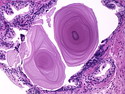
Comments: Corpora amylacea are inspissated secretions that may have a lamellated appearance. Usually they are pink or purple in appearance. Sometimes they may be golden-brown.
20: Corpora Amylacea in Prostate Biopsies
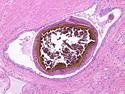
Comments: This image shows a round eosinophilic corpus amylaceum in an atrophic gland. Corpora amylacea are more commonly seen in benign glands and are rare in carcinomas. Over time, they may calcify and form prostatic calculi.
21: Corpora Amylacea in Prostate Biopsies
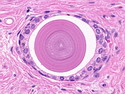
Comments: This image shows a corpus amylaceum with a golden-brown hue surrounded by a ring of eosinophilic material.
22: Pigment in Prostatic Epithelium
Comments: Pigment is a common finding in prostatic secretory epithelium. The pigment is Lipofuscin and consists of oxidized lipids. The pigment granules may be yellow-brown (shown here) or blue-purple (next image). Previously, the pigment in prostatic epithelium was thought to be melanin. However, the presence of melanin in prostate is an exceedingly rare finding.
23: Pigment in Prostatic Epithelium
Comments: This image shows blue-purple granules of lipofuscin in secretory epithelial cells of prostate. Pigment may also be seen in high-grade PIN as well as prostatic adenocarcinoma. Prostatic epithelial cells with pigment should not be mistaken for seminal vesicle or ejaculatory duct epithelium. The finding of atypical bizarre hyperchromatic nuclei favors the latter.
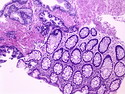
24: Rectal Mucosa in Prostate Biopsy
Comments: Prostate biopsies are usually performed transrectally under ultrasound guidance. Small fragments of incidentally sampled colo-rectal mucosa are not uncommon in prostate biopsy material. The sampled tissue may be columnar or squamous mucosa.
Last Updated: Tuesday, August 03, 2010
 
SLIDE INDEX
Brain
Head & Neck
Mediastinum
Lungs Pleura
Lymph Nodes Spleen
Heart Blood Vessels
Gastrointestinal Tract
Female Genital Tract
Genitourinary Tract
Prostate
Urinary Bladder
Kidney
External Genitalia
Testes
Adrenal
Bone & Cartilage
Soft Tissue
Peritoneum
Endocrine
Breast
Skin
 
SEARCH  
twitter